

by Alexander Wissel, Executive Editor
This week our team has been investigating “the next big thing” in grocery at the National Retail Federation (NRF) “Retail’s Big Show 2026” in New York City.
Training is an issue for retailers – both expanding and established. Grocery training strategies for getting new hires up to speed are critical for growing employee competency and cultural fit. It’s a mission that drives straight to the bottom line. One bad hire’s mistakes can quite literally cost thousands to fix.
We recently sat down with some of our retailer partners who explained how they have been using new methods to get their staff up to speed. It was explained this way: We found that we had old training manuals created by someone who worked years before – which weren’t even being used – so we threw them all out.
Grocers have been dumping the traditional playbook on employee training – no more days (or even weeks) of staring at training videos and PowerPoints. But what are they doing differently?
New Grocery Training Strategies “Gamify” Employee Competency
One particular session at NRF had some insight for us from Glenn Haussman of the No Vacancy podcast and Kyle Eynon, director of training & development at Sprouts Farmers Market.
As many of our readers know, Sprouts Farmers Market (NASDAQ:SFM) has been aggressively adding stores as it has grown from its West Coast base to new markets in the East and Northeast.
Before the end of the month, Sprouts will be opening stores in Haymarket, VA, New Braunfels, TX, and Long Island, NY – their first in New York state. It’s all part of a deliberate expansion strategy. We learned from CEO Jack Sinclair at Groceryshop that Sprouts’ long-term goal was 1,400 stores. 
Sprouts has unique training requirements for its team members to match its boutique grocery and wellness offerings. The company is a year into testing a pilot program with Axonify that serves as a training program and communication platform.
The problem, as Kyle explained, was this: “Our front-line team members are inundated with information. Can we identify the strategic initiatives and give the staff the ability to solve the problems they have, [so we can] align the staff goals with companies goals.”
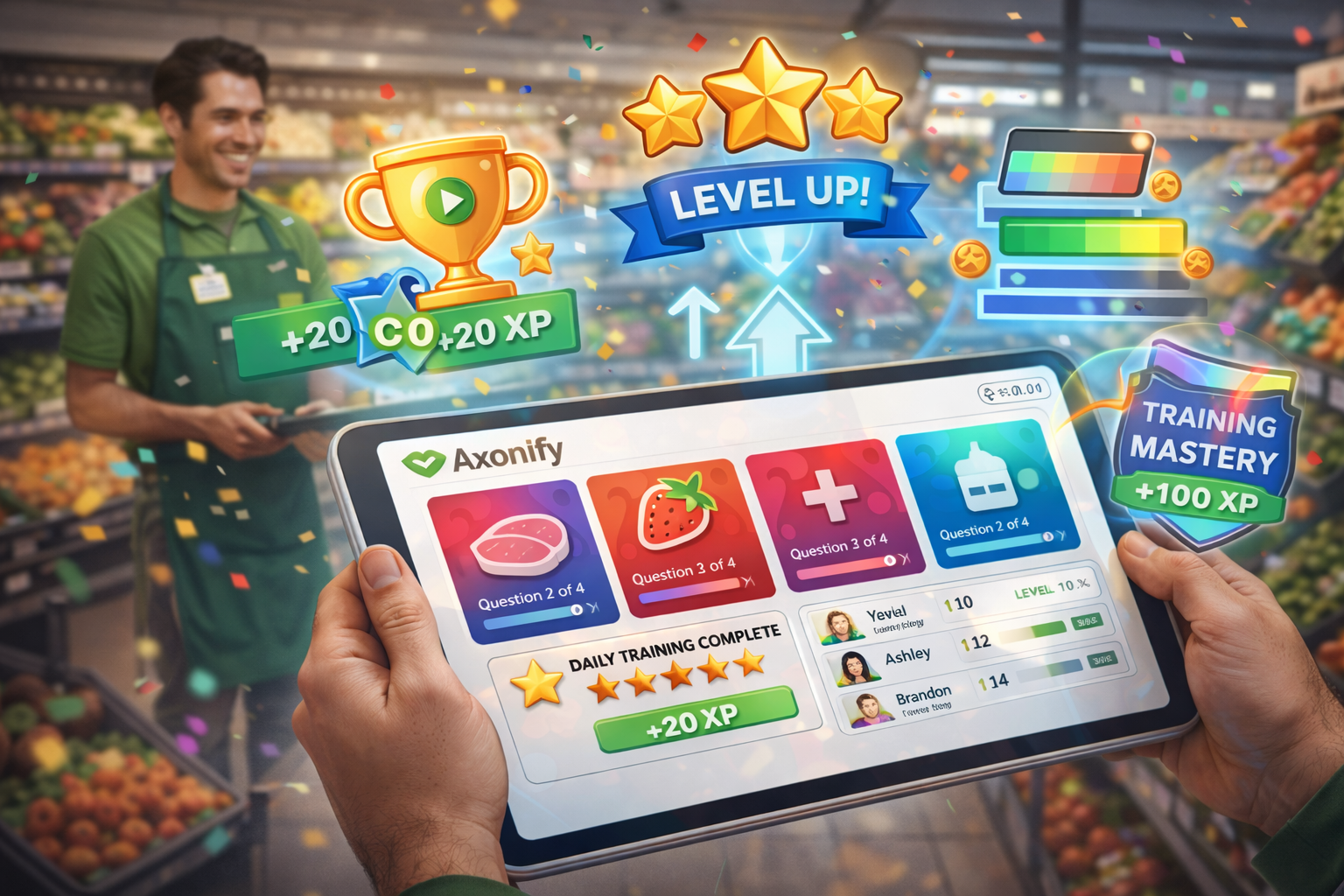
Every employee uses Axonify’s application at the start of their shift. Their personalized application can be accessed through company tablets, computers or a team member’s cell phone.
“Onboarding is when there is usually a lot of training. So we shrunk training. We build content with a bite sized amount of 3-5 minutes. It reinforces things they have learned already.
Breaking it down to one small thing today and reinforcing it tomorrow is the plan.”
Kyle continued, “Before, we weren’t measuring competence. We do now. We are only now just being able to see quantifiable results – because there wasn’t the ability to collect and measure these types of programs and their benefits before.”
They report that the utilization of the program is around 94% and that gamification keeps the interaction fun, quick, and consumable.
Despite sounding like something superfluous, gamification is a way to make simple tests and applications exciting and compelling. If you’ve tried to keep a Wordle streak going or feel compelled to “close your rings” on a health app, you understand its motivating benefits.
Gamified questions through Axonify’s app will reinforce training modules. It will also ask users to give their level of confidence in their answers. An important metric to consider when trying to understand if they are overly confident and inaccurate? This data is fed to managers who can have a one-on-one coaching moment to check the employee progress.
As part of the discussion the importance of managers as a driver for front line execution was made clear. It is the most important role for our 80- to 100 per-store team members. Their buy-in and support is critically important.
Sprouts is also piloting an AI agent to get information into team members hands to make better decisions when faced with customers. They are also using it to identify the greatest points of friction.
“The best parts of technology are when it helps the flow of work. Getting our teams to adopt and use it so they can do their job better and faster, so that it just becomes part of the flow of work.”
Investment in this kind of “front-line” software is important for training at scale. But for smaller operators under 1,000 employees, these investments in software and time may not be economical yet.


