
by Greg Madison
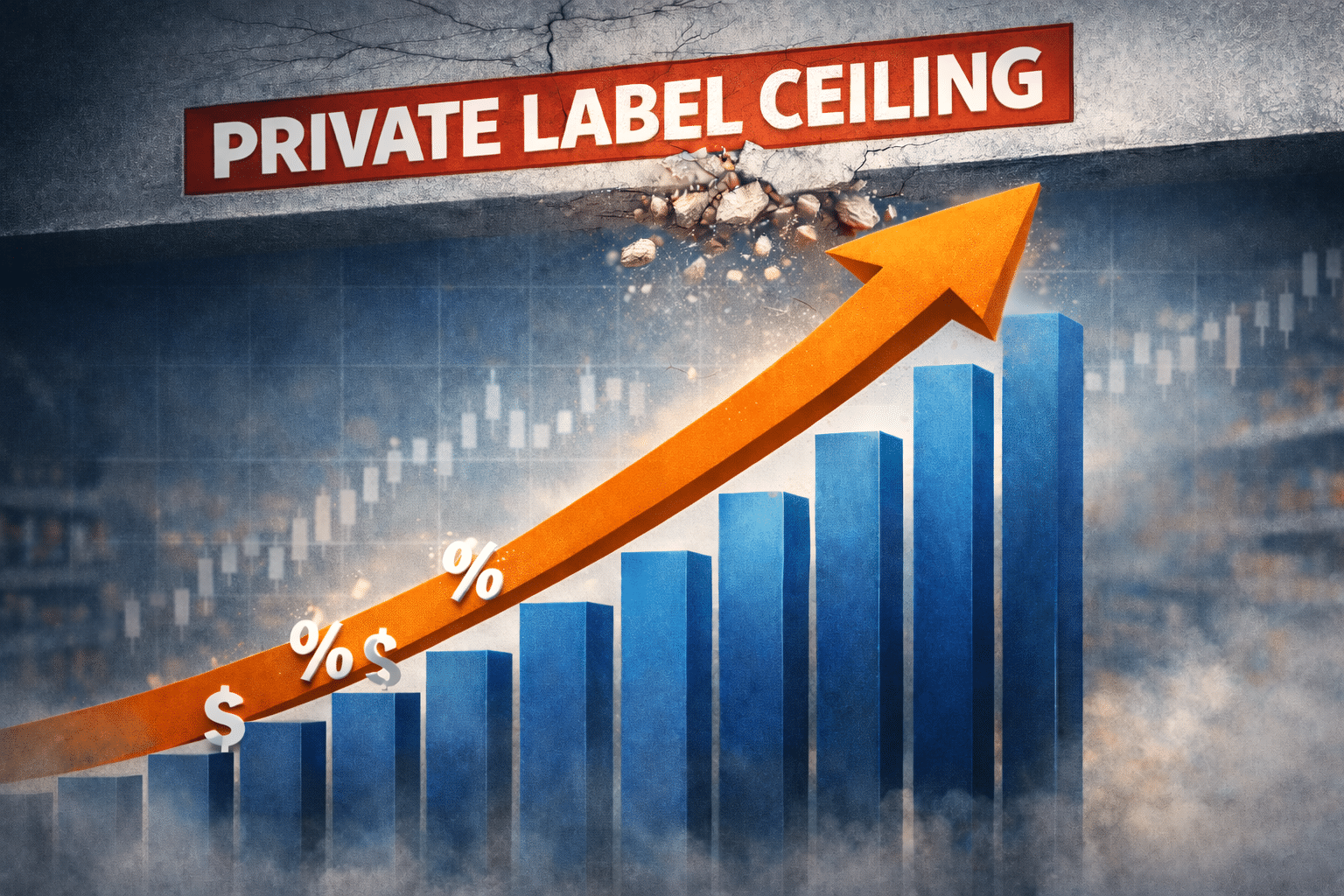
The closure of the quality gap… inflation… the rise of discounters… erosion of brand trust – the stars have lined up perfectly behind private label, and it shows in the remarkable growth to date.
For more than a decade, private label has been grocery’s most reliable growth lever. U.S. private label share has climbed steadily into the 20% to 22% range by unit volume, up from the low teens in the early 2010s, according to multiple industry trackers. In center-store categories like dry grocery and dairy, penetration routinely exceeds 30%, and in some cases pushing materially higher.
That growth wasn’t accidental. Quality gaps narrowed. Packaging caught up. Inflation widened price differentials just as trust in legacy brands began to erode under supply chain issues, “shrinkflation,” formulation changes, and erratic promotions. At the same time, discounters reset shopper expectations around what “store brand” could mean.
For a long stretch, the formula was almost mechanical: upgrade the product, undercut the national brand by 15% to 25%, and let customer trial do the rest.
It worked… until it didn’t. Private label is rapidly approaching ceiling is the rising cost of operational perfection at scale.
Here’s what that means – and what to do about it…
Private Label Has Moved Beyond Branding to Infrastructure
Somewhere along the way, private label crossed a threshold, from being a trial-driven, customer-satisfying “magic bullet” to repeat-driven, from portfolio growth to system stress.
At low penetration, private label is largely a branding exercise. Close the quality gap, clean up the packaging, maintain a visible price advantage, and trial follows naturally.
At higher penetration, though, private label becomes infrastructure – and infrastructure has failure modes.
On paper, private label margins remain compelling, often running 500 to 1,000 basis points higher than comparable national brands. In practice, those gains narrow as SKU counts rise, supplier redundancy shrinks, and forecasting errors grow more expensive. A missed national-brand delivery is an inconvenience. A missed high-velocity private-label SKU — especially one positioned as the default choice – is a potential trust-shaking event.
This is where growth becomes operational, and it’s here where the challenge is different for each retailer.
Chains like Kroger and Walmart don’t lack private-label ambition or brand architecture; both are impressive. What these large chains struggle with consistently is execution at scale.
Private label demands higher standards than national brands. In-stocks matter more. Facings matter more. Substitutions matter more. Miss once, and shoppers begin to hedge.
That hesitation shows up in the data, which is telling. Across many categories, private-label repeat-purchase rates trail national brands by 10% to 20% percentage points, even when trial is strong. Closing that gap is an operational challenge that becomes harder as penetration climbs.
The Private Label Ceiling Is Category-Specific
Where private label runs into friction depends heavily on the category. Take a look at what happens in these five:
In center store, private label penetration is already high, often north of 30%, and the economics are still attractive; shelf-stable products forgive forecasting errors, and quality parity is largely accepted. But growth here has become incremental, constrained by finite shelf space and the trade-offs required to add “one more” store-brand SKU.
In frozen, private label has grown quickly, particularly in vegetables and value-added meals. But the category is unforgiving. Texture, packaging integrity, and consistency matter enormously. One bad experience – freezer burn, say, or soggy breading – can erase months of goodwill. Margins remain attractive, but repeat behavior is fragile.
Dairy tells a different story. Penetration is extremely high in staples like milk, eggs, and butter, and repeat rates are strong. But margins are thinner and volatility is constant. Here, the ceiling is black-and-white economics; there’s only so much upside left to capture.
Then there’s fresh, where the ceiling is lowest and the risks are highest. Selling days, shrink, weather volatility, local preferences, and event uplift all collide. Private label in fresh is constrained by execution precision, though, and this is often where the system breaks first.
In HBC and specialty categories, private label offers some of the richest margin upside, but also some of the fastest trust erosion. One formulation change or supply disruption, and shoppers retreat to national brands without hesitation.
The takeaway is clear: the private label ceiling is dependent on how forgiving – or not – the category is.
Narrower Price Gaps Change Decisions
As we’ve said, for much of the past decade, private label growth rode on a simple advantage: a wide, reliable price gap.
That gap has narrowed.
Inflation did accelerate private-label adoption among customers, but it also forced national brands to get smarter. Rather than surrendering share, many leaned harder into targeted promotions, deliberate size architecture, and channel-specific SKUs designed to defend key price points without fully resetting list prices.
The result is a more compressed choice set at the shelf. In many categories, private label still carries a list-price advantage of 20% to 25%, but during promoted weeks – when as much as 60% to 70% of volume can move – the effective gap frequently shrinks to 10% to 15%.
At that level, execution has a lot to say about whether the customer goes for private label or not. In other words, price alone is no longer decisive. Shoppers hesitate, compare, and default to familiarity when execution falters. The trade-down is no longer automatic.
Private label has the best chance of winning when it earns the decision in real time; it can’t rest on its price laurels as a standing advantage.
Why Discounters Have an Edge Here
It has to be said, discounters like Aldi experience these limits differently.
With private label penetration above 75%, Aldi’s advantage isn’t branding or innovation. It’s structure. Fewer SKUs. Fewer exceptions. Faster resets. Less ambiguity. The operating system is designed around private label, whereas traditional retailers have retrofitted to accommodate it.
Conventional grocers are trying to scale private label inside far more complex ecosystems, balancing national brand funding, assortment breadth, promotional obligations, and store labor constraints. That complexity can be a drag discounters don’t have to contend with.
The Next Phase of Private Label Growth
Going from 10% to 20% private label share is largely a strategic exercise: define the brand, close quality gaps, price with confidence.
Going from 30% to 35% is something else entirely. At that level, every incremental point demands tighter forecasting, more reliable suppliers, fewer store-level exceptions, and near-perfect execution. Trust has to be re-earned on every trip. This is why private label growth tends to slow quietly before it ever stalls visibly. That’s not because shoppers turn against it, but because the operating system supporting it starts to strain.
This isn’t to say private label is in trouble – nothing could be further from the truth. But the explosive, near-guaranteed growth is coming to an end. Private label has matured.
Once the easy wins and low-hanging fruit are gone, growth moves at the speed of operations, of planning accuracy, in-stock reliability, and consistency at the shelf.


