

by Greg Madison
The numbers are in, and so is the big takeaway: Americans largely respect, even love, their grocery stores. But they don’t trust the price tags.
According to Dunnhumby’s ninth annual Retailer Preference Index, fully 72% of U.S. shoppers rate their primary grocer highly on quality.
Only 43%, however, believe prices are low without relying on discounts or promotions. That perception gap is as wide today as it was during the 2021 – 2023 inflation surge, when price growth peaked above 9%.
This helps explain why shoppers continue to feel squeezed, even as headline inflation has cooled to around 2.4%. Indeed, the difference between the hard data – and the increasingly hard feelings of American consumers – is the crux of the issue.
On paper, the U.S. spends just 6.4% of household income on food. That’s the lowest share of any country globally. But that statistic masks a harsher reality. Healthcare alone consumes 20.3% of U.S. household spending, the highest share among developed nations. Housing, childcare, and insurance costs have also outpaced wage growth in many markets.
The result is a consumer who may technically spend less on food than peers abroad… but feels far more financially insecure.
Right Now, Shoppers’ Feelings Are the Fact
In 2026, grocery has become one of the few remaining “pressure valves.”
Unlike rent or insurance premiums, food spending can flex. Shoppers can switch stores. They can trade down on brands. They can split trips across banners. And increasingly, they are doing exactly that.
Dunnhumby’s data suggests that saving customers money now accounts for 41% of a retailer’s long-term odds of success – a record high. But the mechanism of savings matters. Promotions and loyalty programs may create moments of value, yet they often fail to create a feeling of value.
In other words, if shoppers are compelled to use or scan apps, clip digital coupons, or alter baskets week to week just to manage their totals, the burden shifts onto them.
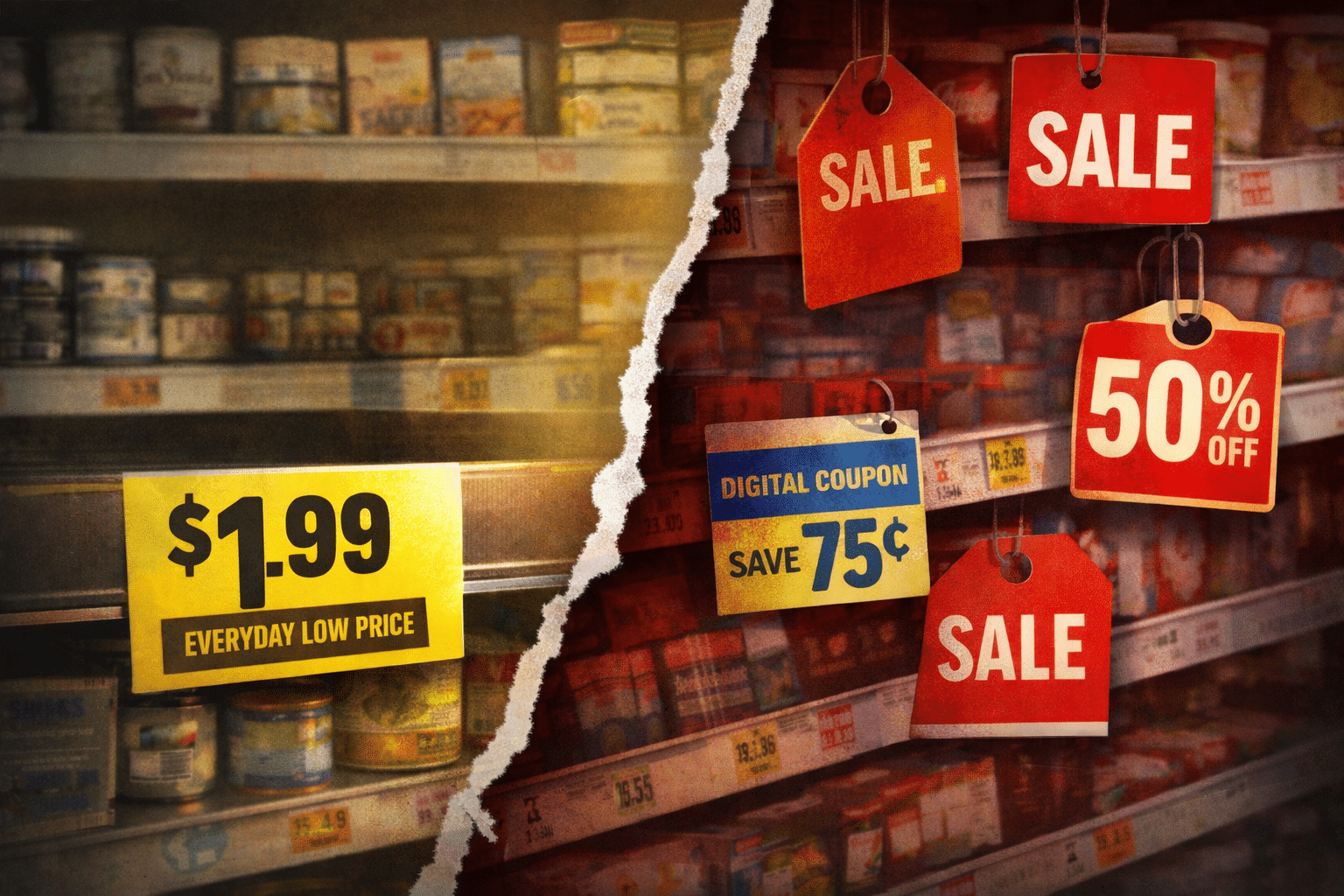
Base price tells a different story. Everyday shelf pricing (before coupons or discounts) accounts for an estimated 40% to 60% of how shoppers perceive a store’s affordability. When base prices feel fair, trust rises. When they don’t, no amount of circulars or digital offers fully repairs the trust/perception gap.
This Dynamic Is Shaping Competitive Positioning
Operators built around everyday low price “EDLP” models – like Aldi, Market Basket, and WinCo Foods – continue to benefit from structural credibility on price. Walmart has invested heavily to reinforce the same perception.
At the end of the day, these retailers ask shoppers to do less work to feel confident about their carts.
Meanwhile, banners leaning heavily on promotions risk deepening the disconnect. Coupons work best as a bonus – particularly on shelf-stable items or known brand purchases – but they are a poor substitute for structural affordability. They can lower a basket total… but they rarely lower anxiety.
Inflation may have slowed. Prices, however, have not meaningfully reset. Shoppers remember what items cost in 2019 and 2020. For better or worse, that memory anchors their expectations and colors every shelf tag they see today.
The larger implication for 2026 is straightforward: quality is table stakes and price trust is competitive advantage. In a consumer environment defined by financial fragility, retailers that simplify savings stand to be the ones that close the trust/perception gap.


