

by Greg Madison
We’ve been talking a lot about the next “phase” in AI adoption in grocery. The industry is steadily – admirably – moving past the hype and asking pointed questions about the use-case for AI and what it can really do for day-to-day operations.
By 2032, grocery won’t talk about “AI strategy” the way it once did. The hype cycle will have burned off, the buzzwords will have aged badly. The tools that survive will be absolutely embedded into how pricing is governed, the way promotions are approved, how private label is positioned, and risk is managed day to day.
AI will sit squarely between functions that once occasionally worked at cross-purposes.
Promotions might well become fewer but they’ll be much more intentional. Pricing will become more intentional, not more dynamic. Private label will shift from blunt margin lever to precision positioning tool. Vendor negotiations will be shaped less by anecdote and more by shared history. And execution will increasingly separate the winners from the also-rans.
The real power of these systems will lie in how they connect with one another; learning from overrides, feeding post-promo insights back into planning, and continuously updating guardrails as shopper behavior and economic realities change.
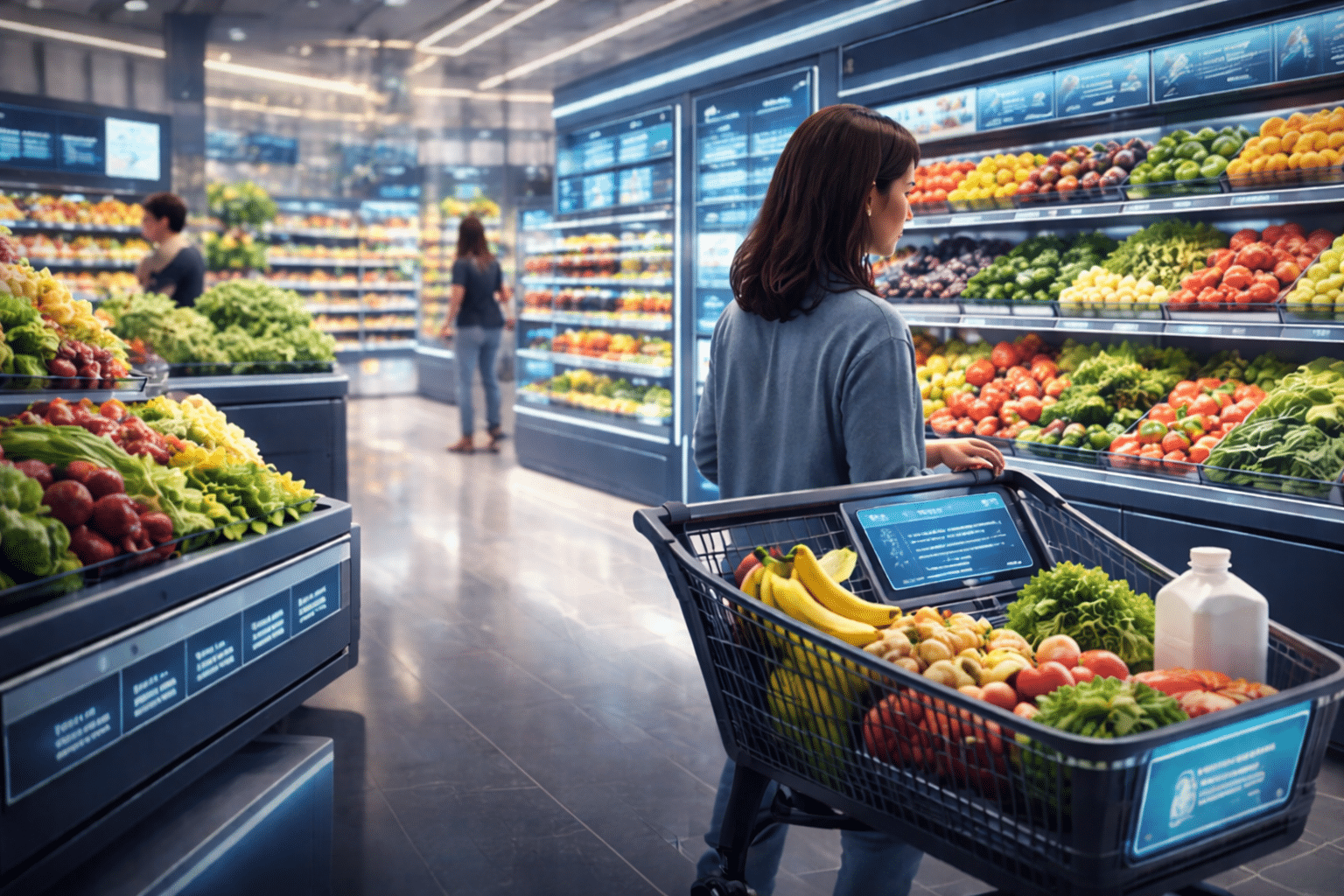
So, taking a page from the old-school World’s Fair and those Nifty Fifties newsreels, let’s take a look at the “Grocery Store of Tomorrow,” opening just a few years from now.
What follows is a snapshot of a single, regular day inside a hypothetical Harbor Grocery Market.
Let’s say Harbor Market is a rather upscale regional chain of 11 stores in the crowded Central Maryland area. It’s where customers go when they want to grind their own coffee beans, have a hankering for imported Spanish tinned seafood, or crave a boutique kombucha.
You know the place.
Most of Harbor Market’s locations run to about 16,000 square feet, but the flagship Baltimore County store boasts a 23,000 sq-ft footprint.
We’ll look at how different groups of Harbor Market’s 725 employees use AI from week to week and day to day in 2032…
The Most Productive Meetings Ever
The meeting starts at 7:42 a.m., not because that’s when everyone’s free, but because that’s when the operating system finishes gaming out its overnight scenarios.
People used to call it “the AI meeting,” but no one calls it that anymore.
On the screen are three options for next week’s pricing and promotion moves. They don’t read like commands – or recommendations, for that matter. Just three paths, each with a short explanation written in plain English:
“Low Risk… Balanced… Aggressive…”
Back in 2025, the same room would have been louder. Merchants arguing over promo depth. Finance warning about margin erosion. Someone insisting, again, that dynamic pricing would fix everything if people would just trust it.
By 2032, that phase is long over.
What changed wasn’t the technology. It was the expectation.
Back in the early 2020s, during peak AI hype, grocers tried to use AI to be right. To predict demand perfectly. To price every item at its theoretical optimum. To automate decisions humans had always argued over.
It mostly backfired.
Prices moved too fast. Shoppers noticed. Worse, the news media noticed! Store teams didn’t trust what they couldn’t explain. Merchants overrode the system so often that models often learned the wrong lessons. The tools promised certainty and good order… and delivered anxiety and mayhem.
So the goal shifted.
Instead of asking AI to decide, grocers asked it to uncover risk.
That’s why the morning meeting just… works now. Each option shows not just expected lift, but where things tend to break: which stores historically go out of stock, which categories cannibalize each other, which promotions quietly increase shrink in certain neighborhoods.
What human debate there is no longer centers on what to do, rather, the human focus is on which risks the organization is willing to own.
Promotions: Fewer but Much More Successful
Later that morning, the promotions team reviews the next four-week calendar. Industry vets notice there are noticeably fewer deals these days than there were in the 2020s.
Each one carries a short narrative summary:
This promotion historically performs well, but execution risk is high in stores with labor gaps. Net margin depends on display compliance.
Another is flagged:
High likelihood of pulling volume from private label for 21 days post-event.
Nothing is blocked. Nothing is automated away. The humans in this room are very much calling the shots.
But it’s harder now to pretend a deal is “free.”
In the past, promotions were planned around upside. By 2032, they’re planned around downside containment. AI has effectively made promos more accountable.
The result isn’t fewer promotions because of austerity. In reality, there are fewer promotions because the system finally shows the full cost of running them.
Dynamic Pricing Gets Quiet
At midnight, prices quietly update across four of the chain’s 11 stores on electronic labels. No alarms. No visible swings. In fact, the price changes aren’t all that widespread, and they certainly aren’t drastic.
Yes, for all the bad press and strife of 2025, dynamic pricing still exists… just not the way salespeople and tech gurus promised in the hype-y slide decks back then.
And it’s certainly not done in the way that provoked such a backlash a few years ago. Every individual in the store at the moment, middle- or working class, college-educated or not, male or female, pays the same price at the same time – period. No exceptions.
(Nobody wants a repeat of what happened to Instacart back in 2028… Yikes.)
But prices move within very narrow bands that were approved months ago. For all the focus on “dynamics,” it turns out the system actually recommends holding prices steady more often than changing anything.
When the system does suggest a move, it explains why… and it clearly lays out the risk to customer trust – public opinion – if the change is reversed. There will be times the system recommends posting details about why a specific price has moved up, or why a product is out of stock and how long that is expected for.
The customer trust figure has become so important that it becomes part of the change metric calculations.
By 2032, grocers have finally learned that price volatility is the third rail of modern grocery. Yields are as close to optimum as it’s possible to get, it all works predictably and fairly, and margin is sewn up tight.
Private Label Finds Its Moment All Over Again
In the afternoon, the private label group reviews a new item proposal. Not a trend play but exploiting a gap. The system flagged an obscure, subtle but very real recurring pattern. When it brought it to the human team’s attention, it provoked a genuine “ah-hah!” moment…
Buried in the data, AI dug up a gem: When a national brand crosses a certain price threshold, shoppers don’t always trade down. It turns out that sometimes, they just leave the category.
And so the opportunity here wasn’t to be cheaper. It was to be positioned exactly there.
The product launches quietly. No hero promotion. No bold claims. It just shows up – priced where the math says it should be, and left alone long enough to earn trust.
By 2032, private label is no longer a blunt margin lever; it is a laser-precise market weapon, and one of AI’s most consistent use cases.
Vendors Hear “No” – Backed by Evidence
Joint business planning looks different in 2032, too.
When a vendor proposes a familiar promo package, the response is calm and backed by history:
We ran a similar event last year. Incrementality was limited. We’re open to fewer events at greater depth.
There’s no drama. No gut feel versus spreadsheet showdown.
AI didn’t eliminate negotiation. It eliminated selective memory.
Trade spend didn’t shrink – it just stopped being treated as house money. Profit margins become more standardized as a result.
The Floor Gets Big, Quiet Changes, Too
The deli counter opens at 8 AM sharp; the prep list has already settled.
Behind the counter there is a 20” screen bolted just below eye level – the one that replaced the clipboard a few years back. Orders can come in through customer apps as soon as they enter the store and in-person.
The console doesn’t bark orders and it doesn’t flash red. It just shows what matters today: how much turkey to cut before lunch, which cheeses are likely to run hot after 4 PM, and which prepared items to hold back because it turns out demand almost always fades when the temperature climbs past 80 °F.
Back in 2025, this particular part of the day involved guesswork. Someone would over-prep out of understandable caution. Someone else would under-prep out of habit. By mid-afternoon, customers would be waiting, waste would be piling up… and the blame would land nowhere in particular.
Now, the counter runs quieter. The words “we just ran out” are never heard. The work is still physical, still human, but the bad surprises show up less often.
Up at checkout, the specific change is a little harder to point to, but just as real.
This shift starts at 3:30, peak hour looming. The line builds, then steadies. When something goes wrong – a mis-scan, a weight mismatch, a price that doesn’t line up – the system flags it before it turns into a miniature logjam. Back in the day, a light above the checkout would flash and the customer would have to “please wait for assistance,” but no more.
In fact, most fixes happen upstream now. Fewer overrides. Thanks to electronic shelf labels and RFID-type technology running on a closed system – no surveillance pricing — there are just plain fewer moments where a customer insists the shelf said one thing and the register says another.
Years ago, checkout was where just about every upstream mistake in the book landed – with a thud. Pricing errors. Promo confusion. Inventory gaps. Today, checkout is like a river. Flow. Pace. Things move. No one is frustrated.
The vibe upfront is less hectic and customers and employees alike appreciate it, even if they don’t fully understand why. In fact, the customer experience is greatly improved as stores recognize the checkout is one of the last places to connect with shoppers on a personal level.
No one calls this “AI on the front line.” No one talks about models or systems at the counter. What the team talks about is whether it’s been a rough shift.
And increasingly… it hasn’t been.
For staff working the store, for management doing the planning, for the teams working execution, for the customers shopping, the grocery store of 2032 just feels pretty good – great, even – all around.
Instead of stores overwhelmed with the technical and logistical challenges that pull attention away from their purpose, staff is able to focus on selling and customer service.
Instead of an employee simply focused on putting items on the shelf, they are selling the benefits of a specific brand, seasoning, or fruit like a sommelier would a new wine. Their knowledge becomes a shared experience for their customers.


