

by Zachary Zawila, Special Contributor
Amazon Fresh and Amazon Go are dead. The formats, originally hailed as a new standard in checkout-free retailing, ended abruptly with Amazon’s January announcement that the stores were all closing, with only Whole Foods Market remaining as Amazon’s presence in brick-and-mortar retail.
Amazon is rethinking their retail strategy, including greatly expanding the Whole Foods banner and introducing a new superstore bigger than a Walmart Supercenter. So if the core differentiator for Fresh and Go – easy checkout without going through a register – wasn’t enough to keep the chains alive, is that even worth pursuing for Amazon and other retailers?
Unequivocally, yes.
Amazon wasn’t the first to introduce alternative, easier checkout methods, and those formats live on after the closure of Fresh and Go. The key, though, is that they’re almost always paired with well-run, relevant stores where customers are already shopping. The customer acquisition process for new Fresh and Go locations and their technology was an uphill battle to begin with.
Smart Carts Showing Up in Amazon-Owned Stores and Others
Although the original Amazon Fresh format was a completely checkout-free “just walk out” format, the chain eventually settled on using Dash Carts, a proprietary smart cart that allowed customers to scan and bag items in the cart.

Amazon still believes in the Dash Cart. It’s been rolled out to several northeastern Whole Foods locations, beginning with one in Westford, Massachusetts.
It functions the same way as the original Fresh iteration, and a designated Dash Cart lane at the front-end allows customers to exit without going through a checkout. As Amazon expands its other retail formats, it’s likely that the Dash Cart will stick around, although the expanding Whole Foods Daily Shop small-format stores aren’t getting Dash Carts, presumably because of the limited sales floor space that would make maneuvering the large, heavy carts difficult.
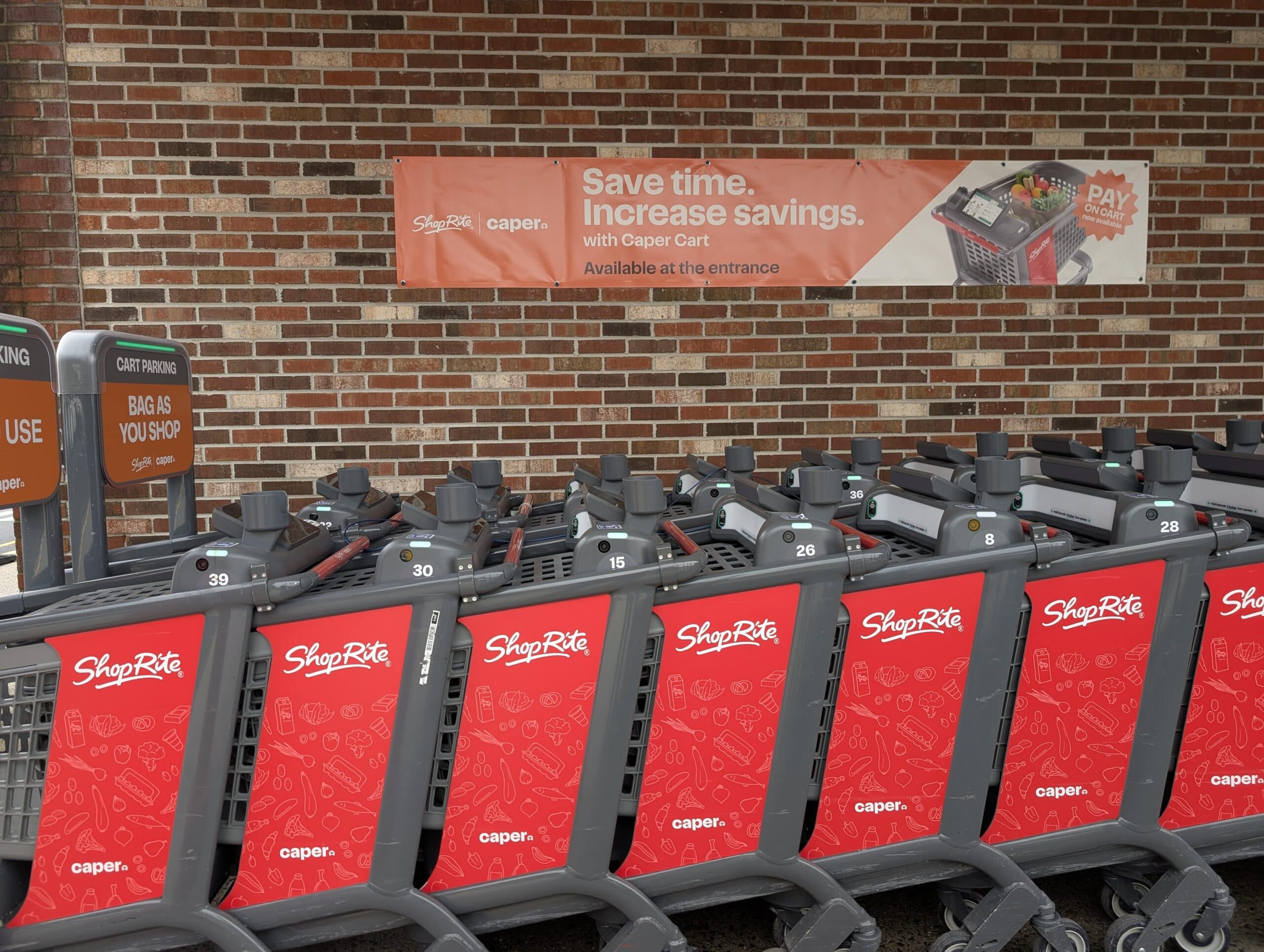
Amazon has good reason to continue to be optimistic about the Dash Carts: It’s a format that other stores are using and expanding, too. Instacart has introduced Caper Carts, a nearly identical smart cart that’s designed for independent grocers. In the northeast and mid-Atlantic, it’s been introduced at ShopRite stores, though Wakefern hasn’t disclosed exactly how many of its stores use the carts.
As usual, smart carts have their limitations. Since it’s still a relatively new technology, retailers are working out kinks in real time. On one shopping trip, a Caper Cart couldn’t identify any bakery items, as the PLU codes hadn’t been input yet; on another, a store clerk had to review video footage of the cart when a package of chicken salad scanned as a hot pepper cheese.
Smart carts have a lot of advantages for retailers, including location sensing that allows for ads and coupons to show up on the screen when a customer walks near that item.
Mobile Apps: Easier for Customers… Easier for Thieves
Several chains have introduced mobile apps that allow customers to scan bar codes as they shop directly from their phones. As yet, this isn’t available at any Amazon stores, but Big Y, Stop & Shop/Giant, and select ShopRite locations have this technology enabled.
A customer downloads the mobile app (typically separate from the retailer’s loyalty or ordering apps), then uses their phone camera to scan bar codes and bag groceries directly in the cart. On the way out, the customer either goes through a self-checkout to get a code or scans a QR code posted at a designated checkout station.
No special technology is required, other than an app that interfaces directly with the customer’s phone camera, so these methods are very easy to use.
Although these apps have become widespread only recently, the idea dates back at least to 2005, when Stop & Shop introduced its Scan It mobile scanners. These handheld devices, located at the front of the store, allowed customers to scan the barcodes of items as they shopped. As with today’s apps and smart carts, the total order was visible on the screen.
Many Ahold Delhaize stores still use Scan It devices, but the technology is now integrated with a mobile app, so the separate devices are no longer as necessary.
This process, though, puts a lot of trust in the customers to scan correctly. Wegmans, which used a similar app until 2022, cited inventory losses and shoplifting as the reasons why it ended the program. The retailers that still use the apps implement random audits to check customers’ totals, though of course that won’t catch every scanning error: intentional or not.
But while the technology is intended to reduce friction, the audits increase it. ShopRite’s audit procedure results in every item being re-scanned by a clerk. One example from another retailer of an order often flagged for review consisted only of a single bottle of water – something that should be easy to buy quickly.
The truth is that no retailer has found the perfect checkout alternative yet, but these promising technology options live on and are even expanding in a post-Amazon Fresh world.


