
by Food Trade News Team
The good news: Grocery prices edged lower in March, offering beleaguered consumers a modest break at the shelf.
The bad news: There’s been no shift in the underlying trend, and prices are still up year-on-year.
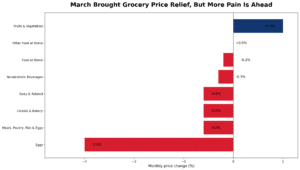
According to the Bureau of Labor Statistics Consumer Price Index released earlier this month, food-at-home prices fell 0.2% month over month. On a year-over-year basis, however, grocery prices remain elevated, up 1.9%.
The price declines were broad but uneven. Four of the six major grocery categories moved lower, led by meats, poultry, fish and eggs; cereals and bakery; and dairy, all down 0.6%. Egg prices – one of the most volatile categories over the past year, and one which has experienced the most pronounced correction – fell 3.4%, while nonalcoholic beverages declined 0.3%. Fruits and vegetables were the exception, rising 1% for the month.
Zoom out, and the pattern becomes clearer. Dairy and proteins are easing slightly year over year, down 1.6% and 0.9%, respectively. But other categories are still climbing, led by nonalcoholic beverages (+4.7%) and produce (+4%). Center-store categories continue to post steady, moderate increases.
A separate read from Numerator reinforces the same trajectory. Its March Consumer Goods Price Index showed prices for everyday household purchases slipping 0.02% for the month, but still up 2% compared to a year ago.
That mix – monthly softening alongside stubborn annual gains – lines up closely with the latest outlook from the USDA Economic Research Service. The agency expects grocery price inflation to continue in 2026, but at a more moderate pace, roughly in the low- to mid-2% range, below the long-term average.
At the same time, that moderation masks significant category-level volatility. The USDA is projecting sharper increases in areas like beverages, sugar and sweets, and beef, while prices for eggs are expected to continue to fall meaningfully.
In other words, the headline number is stabilizing, but the price of the overall basket is not.
Here’s Why It Matters
This is really a story of transition. The era of broad, across-the-board price increases is giving way to something more uneven, harder to manage, and tough to plan for. For retailers, the challenge is now navigating the mix: where costs are still rising, where they’re falling, and how shoppers respond in real time.