


America’s shrinking cattle herd, declining number of ranching operations and concentrated meatpacking industry have created a supply problem that no supermarket can solve via pricing alone. Affordable beef could remain elusive through 2027 and beyond.
The price of beef has become one of the most persistent pain points in America’s grocery bills. The United States has fewer cattle than at any point in decades, but consumer demand is strong and production costs keep rising.
The U.S. cattle herd stood at approximately 86.2 million head at the beginning of 2026, its smallest level in 75 years, according to the U.S. Department of Agriculture (USDA).
From June 2024 through May 2026, retail Choice beef prices increased approximately 27%, while live cattle prices climbed 37%, according to USDA data cited in a June analysis by the protectionist lobbying group Coalition for a Prosperous America.
The bottom line is rising livestock costs have become a major driver of retail beef inflation.
There’s really no good news for consumers or supermarket operators here.
A Shrinking Industry Serves a Booming Market
The contraction in American cattle production has been building for nearly 30 years. The 2022 Census of Agriculture counted 732,123 cattle operations, a decline of 17% from 2017. Zoom out and compare with 1997, and you discover the country has lost more than 450,000 operations. Consolidation, rising land and operating costs, drought and the financial difficulties facing smaller ranches have all contributed to that immense decline.
That said, fewer operations don’t necessarily mean proportionately less production. Larger ranches and improvements in breeding, feeding and animal weights can offset some of the losses, but incremental efficiencies haven’t staved off the national herd shrinkage.
And of course higher cattle prices don’t guarantee strong producer profits. Ranchers face substantial expenses for land, feed, equipment, financing and animal care. USDA data show that 71% of U.S. farms and ranches across agricultural sectors had operating profit margins below 10% in 2024. To be clear, that figure isn’t specific to beef producers, but it is illustrative of the broader financial pressures prevailing today.
There’s a Long Road to Recovery
Unlike manufactured products, cattle supplies can’t respond quickly to higher prices. It’s just not possible. A rancher looking to expand has to retain heifers and cows for breeding rather than sell them. Those animals require feed, land and care long before their offspring enter the beef supply.
Drought has made a tough situation worse. Earlier in 2026, approximately 75% of the American beef cow herd was experiencing drought conditions, compared with a long-term average near 20%, according to figures cited by the Coalition for a Prosperous America. And the return and spread of New World screwworm through Mexico has disrupted live-cattle imports, affecting an important source of animals for U.S. feedlots.
The USDA’s November 17 outlook provides fresh, hard evidence of the slowdown. September feedlot placements fell 12.3% from a year earlier; marketings declined 6.6%. Less than 14% of cattle available outside feedlots entered feedlots during the third quarter. That’s the lowest percentage since records began in 1996.
All that said, there’s a (potentially) encouraging development buried in those numbers. The USDA notes that similarly low placement rates have occurred during previous transitions from herd contraction to expansion – periods when ranchers begin retaining more animals for breeding. However, heifers still accounted for 37.8% of cattle on feed October 1. That’s a relatively high share that tells us any rebuilding remains in its early stages.
Fewer cattle going into feedlots ultimately means fewer available for slaughter. Heavier carcass weights can partially offset the decline, but they can’t fully replace the animals lost from the production system.
USDA Expects Another Year of Tight Supplies
The latest USDA forecasts offer little indication that domestic beef supplies will improve in 2027. In its November 10 World Agricultural Supply and Demand Estimates report, reinforced by the November 17 Livestock, Dairy, and Poultry Outlook, USDA lowered beef production projections for both 2026 and 2027.
The agency expects domestic production of 24.762 billion pounds in 2026, declining to 24.520 billion pounds in 2027, a reduction of approximately 242 million pounds, or 1%. USDA lowered its 2027 forecast by 155 million pounds from October, reflecting fewer cattle expected to reach slaughter early next year. Its 2026 projection declined by 40 million pounds.
The bottom line: Cattle prices are seen to remain elevated. USDA’s November 17 outlook projects average slaughter steer prices of $237.50 per hundredweight in 2027, compared with $236.31 in 2026. Those are livestock prices, not retail beef prices, but they illustrate the continuing cost pressures throughout the supply chain.
Imports Help Fill the Gap
Imports are increasingly important to the U.S. beef supply. USDA forecasts beef imports of 6.436 billion pounds in 2026 and 6.28 billion pounds in 2027, with both projections revised upward in November because of strong demand and limited domestic production. The volume of imported beef has already reached record levels. The department reported third-quarter imports of 1.629 billion pounds – a quarterly record – with shipments from Argentina, Australia, Brazil and Mexico all reaching third-quarter highs. Imports through September were 18% above the same period in 2025.
Volatile trade policy has skewed the picture. While tariffs can increase the cost of imported beef, the federal government has also expanded access to foreign supplies in an effort to moderate prices. In February, Washington authorized an additional 80,000 metric tons of Argentine lean beef trimmings at lower tariff rates. Another 300,000 metric tons were authorized in August, primarily benefiting suppliers such as Brazil.
Trade is a two-way street, however; U.S. beef exports to China plummeted 89% through July compared with the previous year, complicating the economics for producers.
There are some prospects of relief from live-cattle imports. The USDA expects cattle imports to increase from 790,000 head in 2026 to 1.35 million in 2027 as shipments from Mexico recover. Even so, the agency says those additional animals will not fully offset slower domestic feedlot placements.
Imported beef looms large in supplying lean meat used in ground beef production. It can improve availability and moderate price increases for that segment, but it’s no silver bullet. Imports aren’t always one-for-one substitutes for domestic steaks, roasts and other cuts, and they cannot replace the breeding stock needed to rebuild the American cattle herd.
Meatpacking Concentration Complicates the Market
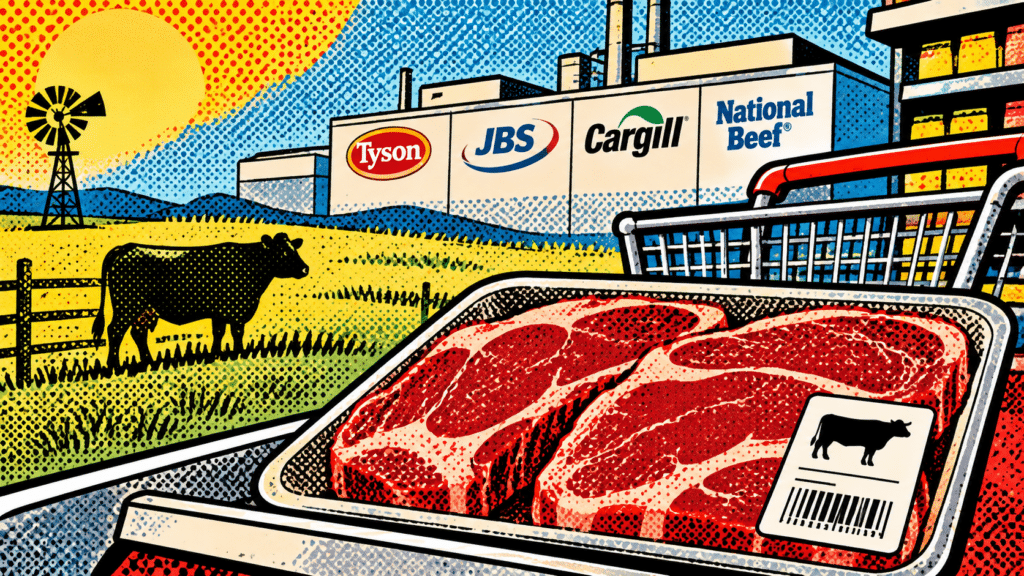
Just four companies — Tyson Foods, JBS USA, Cargill and National Beef — account for approximately 85% of the U.S. fed-cattle market. That concentration creates processing and distribution efficiencies, but it also leaves cattle producers dependent on relatively few major buyers and makes regional processing disruptions more consequential.
For all their market power, meatpackers themselves face difficult economics. Fewer available cattle can mean higher procurement costs, reduced plant utilization and pressure on operating margins. Ranchers with fewer processing options can face weaker negotiating leverage.
None of this is to suggest that meatpackers alone are responsible for higher retail beef prices. Tight cattle supplies can simultaneously produce strong livestock prices, financial pressure on processors and higher consumer prices.
This is a challenge for supermarket operators, to put it mildly. Beef remains an important traffic driver, but the economics keep getting tougher. Retailers can promote selected cuts, adjust merchandising strategies, negotiate supply arrangements and encourage customers to substitute less expensive proteins. But beef products don’t necessarily move in lockstep, complicating efforts to maintain competitive prices while protecting margins.
The November USDA outlook confirms that the industry’s fundamental problem is more or less unchanged. Even if ranchers are beginning to rebuild their herds, it will probably take several years before those additional cattle translate into greater beef production and meaningful relief at supermarket meat counters.
With another decline in domestic production forecast for 2027, just about everything depends on the recovery of the American cattle herd.